Explainer
Articles of association of a GmbH
Published · Updated

The articles of association of a GmbH (limited liability company) are one of the most important elements when founding a GmbH. They set out all the rights and obligations of the shareholders. As a rule, the articles of association must take the form of a notarial deed (Section 4(3) GmbHG).
Single-member GmbH
If a GmbH is established by a single person, the founding document is called a “declaration of establishment” (Errichtungserklärung) rather than articles of association. This is the so-called single-member GmbH.
If the GmbH has only one shareholder, there is the option of founding the company in a “simplified” way. What does that mean?
If the sole shareholder is a natural person and also the sole managing director, there are some simplifications and differences in the formation. For example, the articles of association are called a “declaration of establishment” in this case. In addition, the declaration of establishment does not need to take the form of a notarial deed (Section 9a(4) GmbHG). Nor does the application to register the company with the company register (Firmenbuch) need to be notarised (Section 9a(5) GmbHG).
You can find further important information on the simplified formation here.
Mandatory content of the articles of association
The law sets out the minimum content of the articles of association, although in practice they usually cover much more: the company name, the registered office, the business purpose, the amount of the share capital and the capital contributions (Section 4(1) GmbHG).
Company name
The company name (Firma) is the name of the business that is entered in the company register. It is the name under which the GmbH deals with other parties in business – for example, when the GmbH concludes and signs transactions. The company name can be a personal name, a descriptive name or an invented name. It must include the legal form suffix “Gesellschaft mit beschränkter Haftung” (limited liability company). This may be abbreviated, e.g. to “GmbH” or “GesmbH”. This mandatory suffix is important so that everyone can see that they are dealing with a limited liability company.
A personal name (Personenfirma) means that the civil name of the entrepreneur or the shareholders is used as the company name (e.g. Max Mustermann GmbH). But beware: it is not permitted to use the names of people who are not shareholders in the company name.
A descriptive name (Sachfirma) means that the company’s business purpose is used as the company name (e.g. Immobilienbewertung GmbH, “Property Valuation GmbH”).
An invented name (Phantasiefirma) means that a made-up name is used for the company (e.g. Schlaraffenland GmbH).
Registered office
The registered office of a GmbH is the place where the fundamental management decisions are made. The registered office to be stated is the place where the GmbH’s management or administration is carried out (U. Torggler in U. Torggler (ed.), GmbHG § 5 para. 15) (Section 5(2) GmbHG).
But what does that actually mean?
The purpose of the registered office is to establish where the most important decisions are made or where the GmbH’s main administration is located. You can think of the registered office as the company’s headquarters, so to speak. For this reason, the articles of association must name as the registered office the place where the most important business decisions are made. If a company has several establishments or buildings across the country or around the world, it would be difficult to determine where exactly the GmbH is actually based. The registered office makes it clear where the most important decisions are made.
In principle, a GmbH may only have one registered office, even if it has several permanent establishments or office buildings spread across different (federal) states or countries.
The registered office must be distinguished from the business address. For the registered office, it is sufficient to state the municipality. For the business address, however, the specific address for the service of documents must be given.
If the GmbH’s registered office is to be changed, the articles of association must be amended. This also applies to a move to another municipality or city, because the registered office is a mandatory part of the articles of association. The amendment to the articles of association must in turn be notarised. You can also do this quickly and easily online via notarity.
Business purpose
The business purpose (Unternehmensgegenstand) is the company’s field of activity. It defines the company’s objectives and, as a rule, how the company intends to make its profit.
The business purpose is important because it determines the scope of action of the managing directors and how they are controlled. The broader the business purpose, the more room for manoeuvre there is. However, if the business purpose is too broad, there is a risk that the scope for action becomes too wide and that liability increases as a result.
Completely vague statements are not permitted as a business purpose. Nor is it sufficient to state “meaningless wording” or “empty phrases” as the business purpose (8 Ob 48/71 NZ 1972, 222; VwGH 92/04/0271, 6 Ob 12/90 SZ 63/87, 437). For example, the wording “trade in goods of all kinds” is not permitted (6 Ob 21/79 NZ 1981, 8; OLG Innsbruck 5 R 390/86 NZ 1989, 73, 74).
Amount of the share capital
The share capital is, so to speak, the foundation of the company’s assets. For a GmbH, the minimum share capital is 35,000 euros (Section 6(1) GmbHG). It is possible to found a GmbH with privileged formation (gründungsprivilegierte GmbH), in which case the share capital only needs to be 10,000 euros at the time of formation (Section 10b GmbHG). The articles of association must state the amount of the GmbH’s share capital. However, at least 35,000 euros (or 10,000 euros for a GmbH with privileged formation) must be entered in the articles of association as share capital.
Capital contributions
A capital contribution (Stammeinlage) is the share of the share capital contributed to the GmbH by a particular shareholder. The amount does not have to be the same for all shareholders – it can differ. What matters is that the total of all shareholders’ capital contributions amounts to at least 35,000 euros (or 10,000 euros for a GmbH with privileged formation).
If, for example, someone wants to take a stake of 5,000 euros in a GmbH, this amount must be stated in the articles of association. At least half of the capital contribution taken on must be paid into the company account.
Optional content of the articles of association
Further provisions in the articles of association are useful but not mandatory. You can also choose to regulate the following:
- duration of the company
- business year
- additional contributions
- management and representation
- supervisory board
- general meeting
- bookkeeping and annual financial statements
- appropriation and distribution of profits
- shares in the company
- minority rights
- termination
- dissolution of the company
You can read about which other documents are needed to found a GmbH here.
Articles of association and the company register
The company is registered by entering the articles of association in the company register (Section 11 GmbHG). The application must be made in writing on paper or via the electronic legal communication system (ERV) and signed by all managing directors in publicly certified (notarised) form. You can find out which documents are needed for registration in the company register here.
Sample articles of association and company register application
Here you will find sample articles of association and a sample company register application from the Federal Ministry of Justice. With these samples, you can found a GmbH quickly and easily online via notarity. If the content of the contract is complex, we recommend entrusting the matter to a notary or lawyer.
Via the notarity platform, you can found a GmbH online quickly and easily.
Articles of association as a notarial deed
When a GmbH is founded, the articles of association must be executed as a notarial deed (Section 4(3) GmbHG). The other documents must be signed with a notarised signature. Since 2019, it has been possible to execute the notarial deed online using electronic means of communication (Section 69b NO). In addition, a notarised power of attorney is required if authorised representatives sign on someone’s behalf.
You can complete the notarial deed and the notarisation of signatures with partner notaries entirely digitally via notarity.
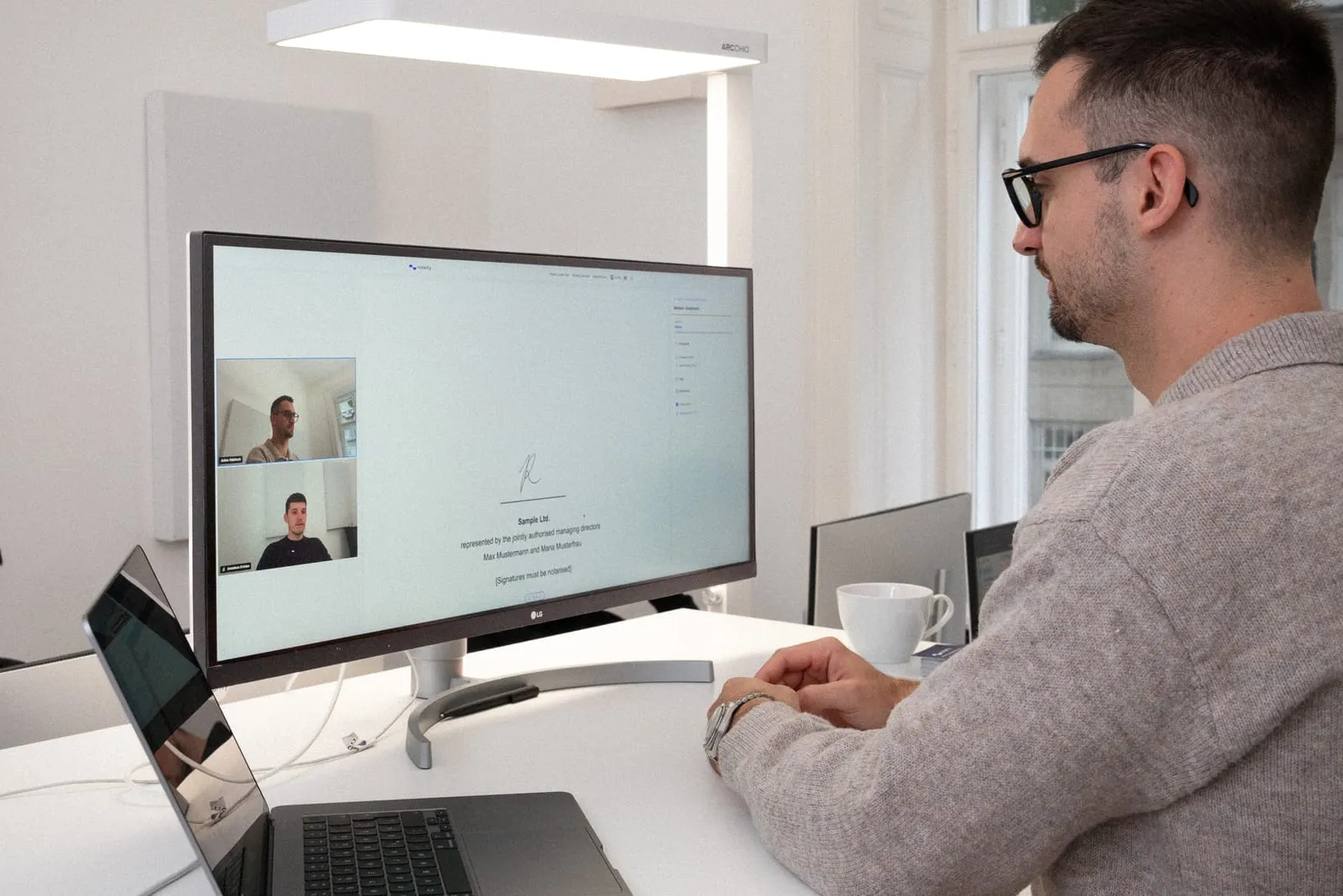
To do so, you meet a partner notary on the notarity platform for an online appointment by video conference. The notary then reads out the articles of association and explains the exact content of the individual provisions. This ensures that all participants know exactly what they are signing and what they are committing to.
You can book an appointment with a partner notary to found your GmbH here.