Embassy legalisation
Embassy legalisation for countries outside the Hague Convention
Embassy legalisation, also called consular legalisation, is for documents used in countries outside the Hague Apostille Convention: notarisation, then legalisation by the Ministry of Foreign Affairs and the destination country's embassy.
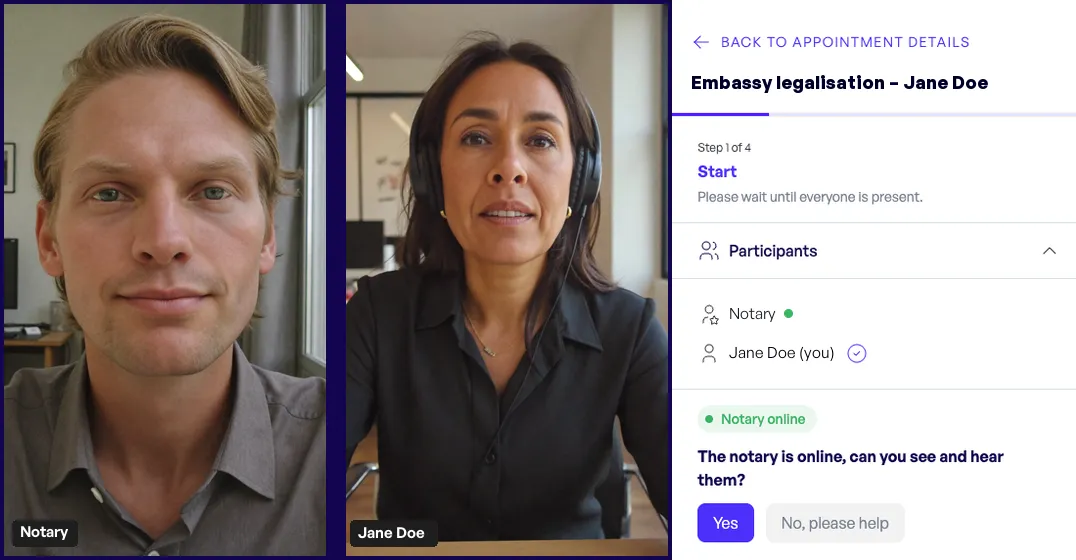
What embassy legalisation is
Embassy legalisation is a multi-step authentication for notarised documents used in a country that is not part of the Hague Apostille Convention. An apostille is one certificate from one authority; embassy legalisation is a chain. The document is notarised, then legalised by the Ministry of Foreign Affairs in the notary's country, and finally by the embassy or consulate of the destination country. Only once every step is complete is the document recognised there. It is slower and costs significantly more than an apostille, so it is only worth it where the destination country requires it.
Apostille
Is an apostille enough?
What matters is where the document will be used, not where you are. If that country is part of the Hague Convention, an apostille is enough, even if you are currently somewhere that is not. For KYC and banking documents, affidavits, travel consent letters for minors or private contracts, legalisation is usually not needed. If in doubt, ask the recipient.
See the apostilleTypical use cases
Company formation and corporate documents
Founding documents and resolutions for a company in a non-Hague country.
Immigration and visa applications
Documents for residence, work or visa procedures.
Property transactions
Documents for buying or selling property.
Powers of attorney and court submissions
Legal representation, and submissions to courts and authorities.
How it works
Embassy legalisation in four steps
How it works
Embassy legalisation in four steps
Embassy legalisation is handled as one complete process via notarity. It cannot be split, with only the notarisation done on the platform.
Book a notarisation appointment
Book a standard notarisation appointment and state clearly in the remarks section that you need embassy legalisation.
Confirm costs and timeline
The notarity team reviews your request and contacts you to confirm the exact costs and timeline. No embassy legalisation is started without your confirmation.
Notarisation
A partner notary on the notarity platform notarises your document in an online appointment.
Ministry and embassy legalisation
The notary's signature and seal are legalised by the Ministry of Foreign Affairs in the notary's country, then by the embassy or consulate of the destination country. The document is then sent to you by international courier.
Frequently asked questions
What is embassy legalisation, and how is it different from an apostille?
An apostille is a single-step authentication recognised in the 120+ countries of the Hague Apostille Convention. Embassy (consular) legalisation is a multi-step process for countries outside the Convention: the document is notarised, legalised by the Ministry of Foreign Affairs in the notary's country, and finally legalised by the embassy or consulate of the destination country.
When do I need embassy legalisation instead of an apostille?
Only if the country where the document will be used is not part of the Hague Apostille Convention, or an authority has specifically asked for embassy legalisation. What matters is where the document will be used, not where you are. For many documents, such as KYC and banking documents, affidavits, travel consent letters for minors or private contracts, it is usually not needed. If in doubt, ask the recipient.
How long does embassy legalisation take?
The process takes around three weeks, depending on embassy availability. It includes the notarisation, legalisation by the Ministry of Foreign Affairs, embassy legalisation and international courier shipping.
How do I order embassy legalisation?
Book a standard notarisation appointment and state in the remarks section that you need embassy legalisation. The notarity team reviews your request and confirms the exact cost and timeline with you. Nothing is started without your confirmation.
Is an apostille enough for documents used in the UAE?
No. The United Arab Emirates is not part of the Hague Apostille Convention, so documents for use there require embassy legalisation. Please check with the receiving authority exactly what they need.
Can I arrange the embassy legalisation myself after the notarisation?
No. It is not possible to do only part of the process via notarity. Please make sure you understand the full process before you book.
Book an appointment now
Online notary appointments with partner notaries on notarity are a simple, fast and flexible way to handle your notarial matters. Book a video call with a partner notary now.